Score guide
Tips to improve your Orbit Dash score
Orbit Dash is not about complicated controls. It is about rhythm, patience, and choosing the right moment to reverse. These tips are written for players who want to survive longer and make their leaderboard score feel earned.
Play the orbit, not the hazard
New players often stare at one red shard and forget the rest of the screen. Instead, watch the orbit path. Your job is to keep the player moving through the safest part of the circle.
Reverse before panic
The best taps happen before the hazard is touching your path. If you wait until the last visual moment, you may already be trapped by the next shard.
Skip risky pickups early
Blue energy is useful, but survival is more important. A pickup is only worth it if you can leave safely after collecting it.
Read danger outside the ring
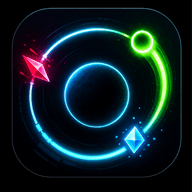
Red shards travel inward from outside the play area. Watch where each shard will cross the ring, then choose a reversal that leaves that crossing clear. A shard near the centre has already crossed your path; the next threat is usually farther out.
Do not spam taps
Rapid tapping can feel safe, but it usually removes control. A clean single tap at the right time is better than several nervous taps.
Restart quickly
Orbit Dash is designed for fast retries. If a run goes badly, restart and use what you learned instead of getting frustrated.
Choose the mission before the run
The Gold Pulse mission counts 35 energy across all of today's runs, so a crash does not erase energy already collected. Blue Plasma requires a single run of 70 points, and Shadow Ring requires 120 in one run. Repeated short runs help the energy mission, but their scores do not add together for either score mission.
Purple Neon needs Level 8, reached after 84 seconds of active play. Deep Run needs 90 seconds in one run. For those targets, a safe reversal is more useful than risking the whole run for one pickup. Pausing stops the run timer.
What survival alone earns
As a planning example, 20 seconds of survival earns about 12 points, 40 seconds about 32, and 60 seconds about 59, before energy or close-dodge bonuses. Every energy pickup adds 5. Two safe pickups can therefore turn a roughly 32-point run into a roughly 42-point run, enough for the 40-point Silver medal. These are examples, not guaranteed scores: your actual total depends on the run.
A better way to practice
If you are stuck at a low score, do not try to force a high score immediately. Play five runs where your only goal is to avoid red shards. Then play five runs where you collect energy only when it is clearly safe. This separates survival practice from score chasing and makes improvement easier to notice.
Once you can survive calmly, start watching for close dodge opportunities. Close dodges can feel risky, but they are part of the skill curve. The best players learn when pressure is worth taking and when a safer route keeps the run alive.
Practice routine
Use short sets instead of endless retries.
Five survival runs
Ignore pickups unless they are directly on a safe path. The goal is to notice how early the next red shard becomes dangerous.
Five energy runs
Collect blue energy only when you already know how you will leave the pickup. This builds the habit of planning one move ahead.
Five pressure runs
Start adding close dodges and quicker reversals. If you crash, name the mistake before restarting so the next attempt has a clear focus.